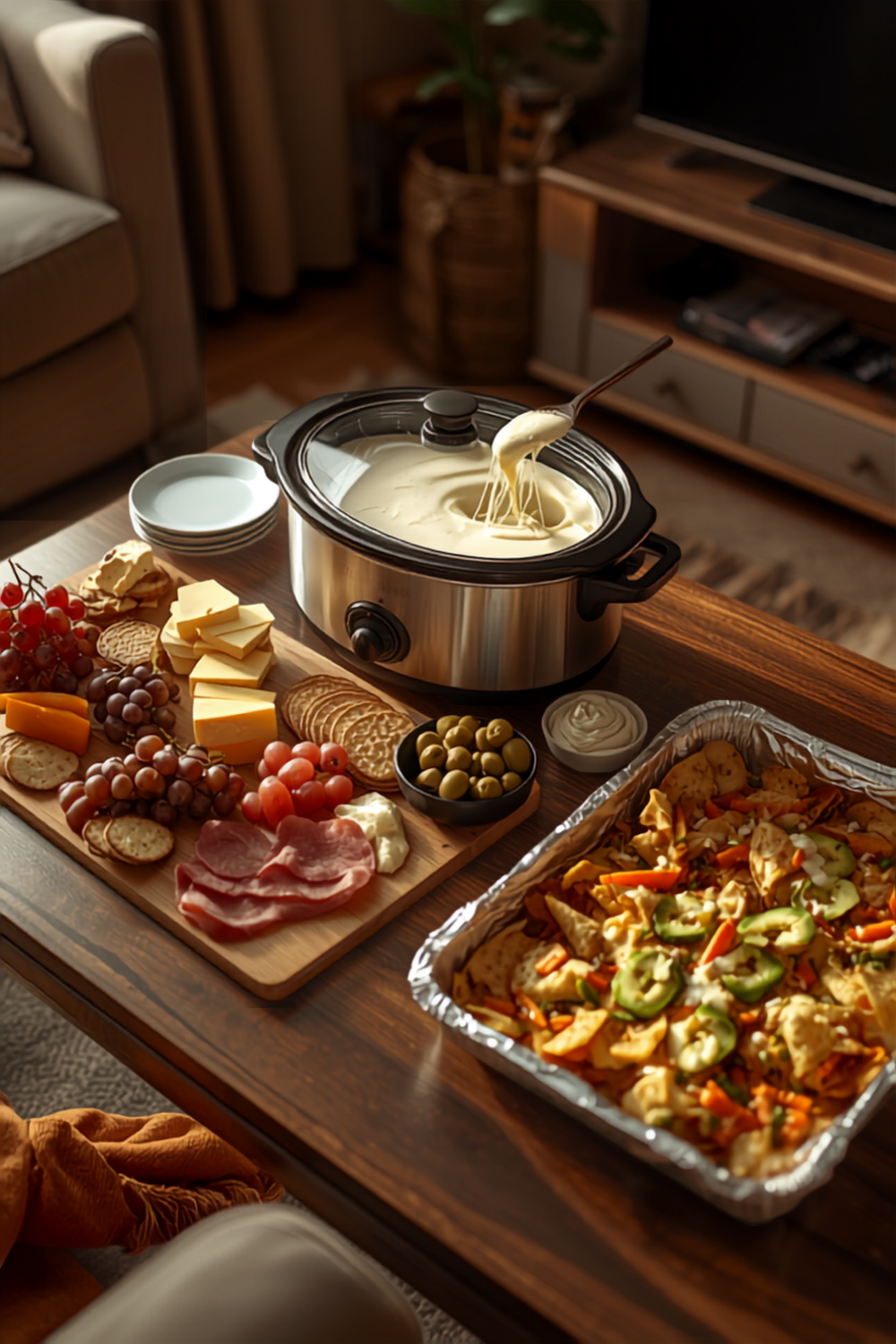
the first real football saturday of the season is this weekend and i have six people coming to an apartment with a kitchen you cannot turn around in. i have hosted this exact afternoon badly before: a bowl of chips, a jar of salsa with the lid still sitting next to it, and me standing at the stove missing the entire first half while everyone else watched the game i invited them to. the fix was not more cooking. it was deciding that a game day spread is exactly three things — one hot thing that holds itself, one cold thing built ahead, and one tray that goes in the oven at halftime — and that everything else is a distraction.
the hot thing is the one that changes the afternoon, and it only works if it can sit out for three hours without turning into a solid orange puck. that means it lives in a slow cooker on the warm setting, not in a pan on the stove that you have to keep going back to. mine is a 7-quart manual crock-pot, which is genuinely oversized for a queso and that is the point: the same pot does meatballs in october, chili in november, and a pulled pork the weekend after that. here's what it actually does:
affiliate link
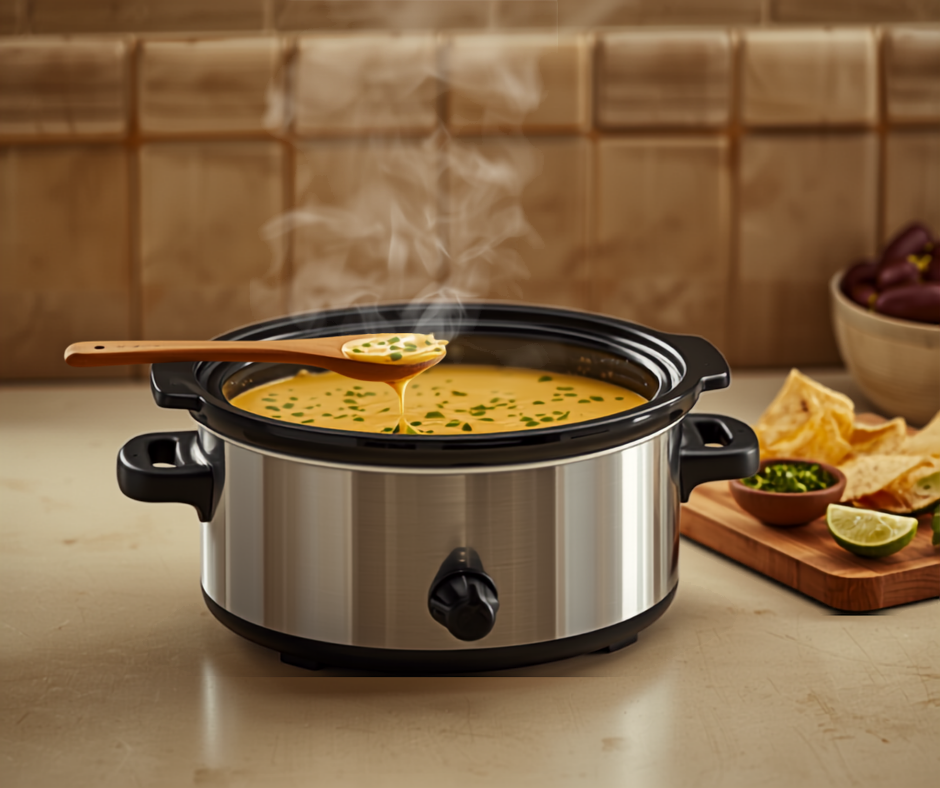
- a manual dial with high, low and warm — and warm is the whole reason this beats a saucepan. it holds melted cheese at serving temperature for hours without cooking it further, which is the difference between queso at kickoff and cheese glue at halftime
- 7 quarts is family-size (it fits a 6-lb roast), so a double batch of queso only fills the bottom third — a shallow pool of cheese heats evenly and stays scoopable instead of setting into a crust at the edges
- the stoneware crock lifts out, so the thing you carry to the coffee table is the insert, and the thing you soak overnight is the insert — the heating base never goes near water
- crock and glass lid are dishwasher safe, which matters more than it sounds when the alternative is scrubbing baked-on cheese out of a pot at eleven at night
- it stays useful past football: meatballs, chili, pulled pork, a big pot of soup, mulled cider in december — it is the one appliance that earns its cabinet space by being boring
the kickoff-minus timeline
before the recipes, the schedule, because the recipes are easy and the timing is what people actually get wrong. everything below is written backwards from kickoff, and none of it has you in the kitchen once guests arrive.
- kickoff minus 4 hours — shop, and grate every block of cheese you own into one bowl. this is the only genuinely tedious job in the whole post; do it once, early, with a podcast on.
- minus 2 hours 30 — sweat the aromatics, load the slow cooker, set it to low.
- minus 90 minutes — build the board, wrap it, put it in the fridge.
- minus 45 minutes — queso goes to warm. board comes out of the fridge (cold cheese tastes like nothing; it needs the half hour).
- minus 20 minutes — oven to 400°F, assemble the nachos on the pan.
- minus 10 minutes — nachos in. they bake while you carry the crock out.
- kickoff — pan comes out, cold toppings go on, you sit down.
1. slow-cooker white queso
about 2 hours mostly unattended, makes roughly 5 cups, feeds 8 with a bag and a half of chips. this is a proper queso — white american from the deli counter, evaporated milk, real aromatics — not a block of orange loaf melted with a jar of salsa. it is the single most requested thing i make and the ingredient list is nine items long.
- 1 lb white american cheese, from the deli counter, sliced thick and cut into ½-inch cubes
- 8 oz monterey jack, grated off a block
- 1 (12 oz) can evaporated milk
- ½ cup whole milk, plus more for loosening
- 1 (4 oz) can diced green chiles, drained
- 1 fresh jalapeño, seeded and finely minced (keep the seeds if you want real heat)
- ½ small white onion, finely diced
- 2 cloves garlic, minced
- 1 tsp ground cumin + ½ tsp kosher salt
- optional: ½ lb chorizo or ground beef, browned and drained; chopped cilantro to finish
- sweat the aromatics first. onion, jalapeño and garlic in a tablespoon of neutral oil over medium heat, 4–5 minutes, until soft and translucent but not browned. it is tempting to throw them in raw and let the slow cooker deal with it — don't. raw onion never fully softens in cheese and you end up with crunch in something that should be velvet.
- cube the american, grate the jack yourself. pre-shredded cheese is coated in potato starch and cellulose to stop it clumping in the bag, and that coating is exactly what makes a queso go gritty. two minutes on a box grater fixes it permanently.
- everything into the crock except the cilantro: both cheeses, evaporated milk, whole milk, drained chiles, the sweated aromatics, cumin, salt.
- low for 90 minutes to 2 hours, stirring every 30. never high — cheese proteins tighten and squeeze out fat when they get too hot, and that's the split, greasy queso you've had at a bad party. the first stir at 45 minutes will look alarming and separated. keep going.
- taste for salt, add cilantro, switch to warm. deli american is already salty, so taste before you add more. on warm it holds three to four hours; a splash of milk and a whisk brings it back any time it tightens.
- if it does break — grainy, oily-looking — take it off heat, add 2 tablespoons of evaporated milk and whisk hard for thirty seconds. the extra milk proteins re-emulsify it. i have rescued this queso at least four times and nobody has ever known.
white american is the non-negotiable here and it's worth saying why, because it sounds like the lazy option and it is the opposite. it's a processed cheese, which in this one context is a feature: it carries emulsifying salts that keep melted cheese smooth and pourable at a temperature where cheddar would seize and weep. the monterey jack is there for flavor, the american is there for physics. ask for it at the deli counter cut in one thick slab rather than sandwich slices and cube it at home — it's faster and it melts more evenly.
2. the snack board, with actual amounts
every board post online shows you a photo and says "arrange artfully," which is useless when you're standing in the store trying to work out how much salami six people eat. so here is the formula i use, per person, for a three-hour game. i build it on a bamboo board with a drawer because in an apartment the knives and the little bowls need to live somewhere, and the somewhere is inside the board itself:
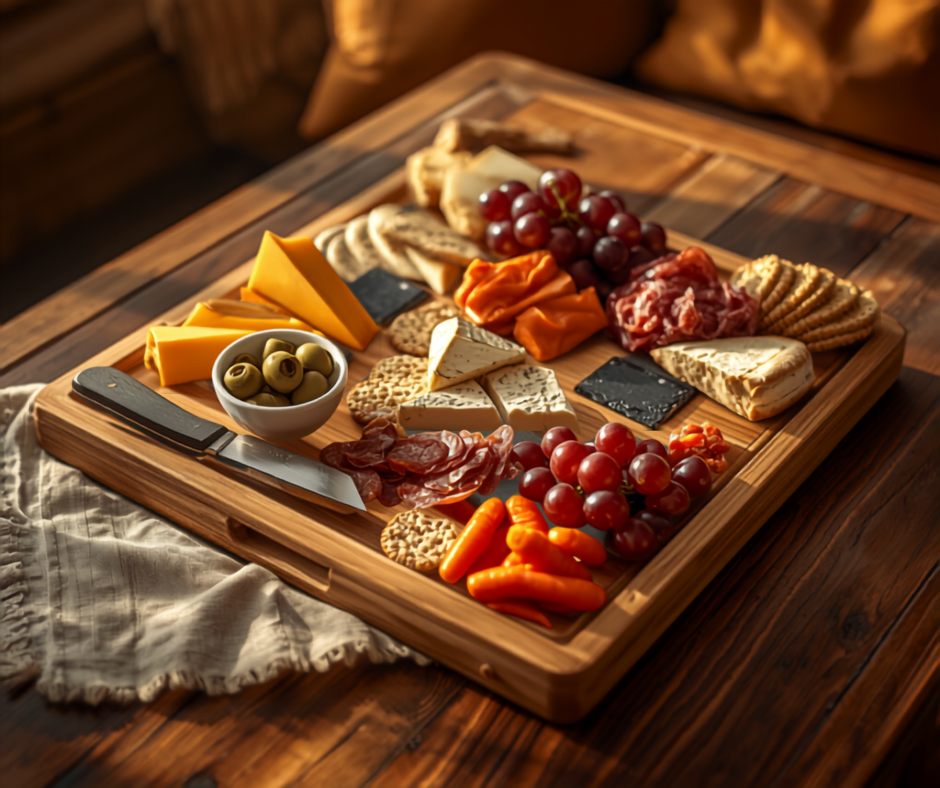
- a slide-out drawer holds the four cheese knives, two ceramic bowls and the slate labels, so the whole kit stores as one object — the reason most board sets get abandoned is the accessories scatter into three drawers and you stop bothering
- two small bowls plus a separate fruit tray, which is what keeps the wet things (olives, cornichons, dip) from soaking the crackers — the actual failure mode of a home board
- 13 x 13 inches of surface: right for four to six people at one sitting, and small enough to actually fit on a coffee table next to a slow cooker without a game of tetris
- bamboo, so it's light enough to carry loaded with one hand, and it's a hand-wash-and-wipe board rather than a dishwasher one — two minutes at the sink, not a soak
- two chalk markers and slate labels come with it, which is a small thing that stops the same four questions about which cheese is which
- 2 oz cheese, in two kinds — one firm to slice (sharp cheddar, aged gouda), one soft to spread (herbed goat, boursin-style)
- 2 oz cured meat — salami, pepperoni, or prosciutto
- 1 oz crackers, plus a small handful of pretzels
- ½ cup crunchy produce — baby carrots, celery batons, mini peppers, sliced cucumber
- ¼ cup something briny — castelvetrano olives, cornichons, pickled jalapeños
- ¼ cup something sweet — red grapes, dried apricots, dark-chocolate almonds
- 1 dip per 4 people (the queso counts as one)
so for six people that's roughly 12 oz of cheese (two 6-oz wedges), 12 oz of meat, a 6-oz box of crackers plus pretzels, three cups of vegetables, and a cup and a half each of the briny and the sweet. write that list on your phone and the store trip takes eleven minutes.
- bowls first, spaced in a triangle. anything wet goes into the small bowls and those get placed before a single other thing lands. three points spread across the board, never in a row — the triangle is what makes the finished board look composed instead of lined up.
- cheese second, already cut. firm cheese into ½-inch batons or thin triangles; soft cheese in its own bowl with a spreader stuck in it. nobody wants to be the first person to hack into an intact wedge, so the board stalls if you leave it whole. put the two cheeses on opposite corners so the board has two anchors.
- meat third, folded not flat. quarter-fold salami slices into little ruffles, or shingle a river of pepperoni between the two cheeses. folded meat has height, and height is what stops a board from reading as a flat plate of ingredients.
- crackers fourth, in two fanned arcs along the outer edge — a pile collapses and goes stale-looking within ten minutes.
- produce and sweet last, jammed into every gap. grapes in small clusters rather than one big bunch, carrots and peppers packed tight against the meat. abundance is the entire visual: a board with visible bare wood reads as picked-over before anyone has touched it.
- refill in the kitchen. when it's half gone, take the whole board away, rebuild it out of sight, bring it back. topping up in front of people looks like scraps; a returning full board looks like there was always more.
build it up to four hours ahead, cover loosely with plastic wrap, and refrigerate — then take it out forty-five minutes before you need it. that resting window is doing real work: cold mutes fat, and fat is where cheese keeps its flavor, so a board straight from the fridge tastes like a board of nothing. the only thing i hold back is the crackers, which go on at the last minute so they stay crisp.
3. sheet-pan nachos that don't go soggy
about 25 minutes, one half-sheet pan, feeds six as the third thing on a table that already has two. nachos have one failure mode and it is water: wet beans, wet salsa, wet anything going into a hot oven steams the chips from underneath and you get a pan of warm mush. the fix is two rules — dry everything, and layer twice.
- 10 oz sturdy restaurant-style tortilla chips (thin ones collapse under the cheese)
- 12 oz sharp cheddar + 8 oz monterey jack, grated off blocks
- 1 lb ground beef, or 3 cups shredded rotisserie chicken
- 1 tbsp chili powder, 1 tsp cumin, ½ tsp garlic powder, ½ tsp salt, ⅓ cup water
- 1 (15 oz) can black beans, rinsed and drained very well
- ½ cup pickled jalapeño slices, patted dry
- after the oven: 1 cup pico de gallo (drained), ½ cup sour cream thinned with 1 tbsp lime juice, 1 avocado diced, cilantro
- oven to 400°F. brown the beef over medium-high for 6–8 minutes, drain the fat, then add the spices and the water and cook 2 minutes more until it's glossy and just barely saucy — not soupy. if there's liquid pooling, keep going.
- dry the beans and the jalapeños. rinse the beans, drain them, then spread them on a paper towel and blot. this thirty-second step is the single biggest difference between good nachos and a chip casserole.
- foil the pan and lay half the chips in one even layer, edges barely overlapping. one layer. resist the pile.
- half the beef, half the beans, half the jalapeños, half the cheese — then do the entire thing again: chips, beef, beans, jalapeños, cheese. two thin layers means every chip gets cheese, which is the entire point of nachos and the thing a single deep pile never achieves.
- bake 8–10 minutes, until the cheese is fully melted with a few browned spots. broil for 60 seconds only if you are standing at the oven door watching, because it goes from golden to burnt in about fifteen seconds.
- everything cold and wet goes on after. drain the pico in a sieve first, spoon the lime crema over in stripes rather than dolloping it, then avocado and cilantro. serve it on the pan itself, on a folded towel or a trivet, straight on the coffee table.
what i deliberately don't do
no wings. i love them and they are a two-hour, one-oven, whole-kitchen commitment that ends with you frying while your friends cheer at something you didn't see. no seven-layer dip either — it photographs beautifully and disappears in nine minutes, and the layers turn to soup on the way down. and no drinks project: the drinks live on their own surface, away from the food, so the crowd splits into two small clusters instead of one traffic jam at the coffee table. i wrote the whole setup out in my drink station post — the station logic is the same in september as it was in july, you just swap the lemonade for cider and put the ice in a smaller bucket.
the broader thing i've learned hosting in a small apartment is that the fewer hot dishes you commit to, the better the party goes — the same principle behind my cozy hosting ideas from the summer, just moved indoors and pointed at a television. one thing that holds itself, one thing built in advance, one thing that takes ten minutes in the oven. the fall version is warmer and heavier and the timeline is identical.
honest pros and cons
the slow cooker: the pros are the warm setting (the entire reason it's here), a lift-out crock that goes in the dishwasher, and 7 quarts that cover queso now and chili all winter. the cons are real — it is a genuinely big appliance, roughly 17 inches across, so in a small kitchen it lives in a cabinet you have to plan for, and it's manual, meaning no timer and no auto-switch to warm. you have to be there to turn the dial, which is fine on a saturday afternoon and not fine if you wanted to leave it going while you're at work. around $45-ish, and it goes on sale often enough that i'd watch for one.
the board: pros are the drawer that keeps the knives and bowls together, the separate small bowls that keep the wet things off the crackers, and a weight you can carry loaded in one hand. cons — 13 x 13 inches is a four-to-six person board, not an eight-person one, so with a bigger crowd you are rebuilding it once mid-game (which the refill rule above turns into a feature, but it is still a refill). it's bamboo and hand-wash only, so it needs a wipe and a dry rather than a soak, and the included cheese knives are perfectly fine rather than heirloom. around $40-ish. worth it if you host more than twice a year; skip it and use a big cutting board if you don't.
and the honest note about the food: the queso is the thing people will remember, and it is also the thing that most rewards doing it properly. the deli counter detour for real white american adds about six minutes to the shop and takes the whole spread from fine to the thing someone texts you about on monday.