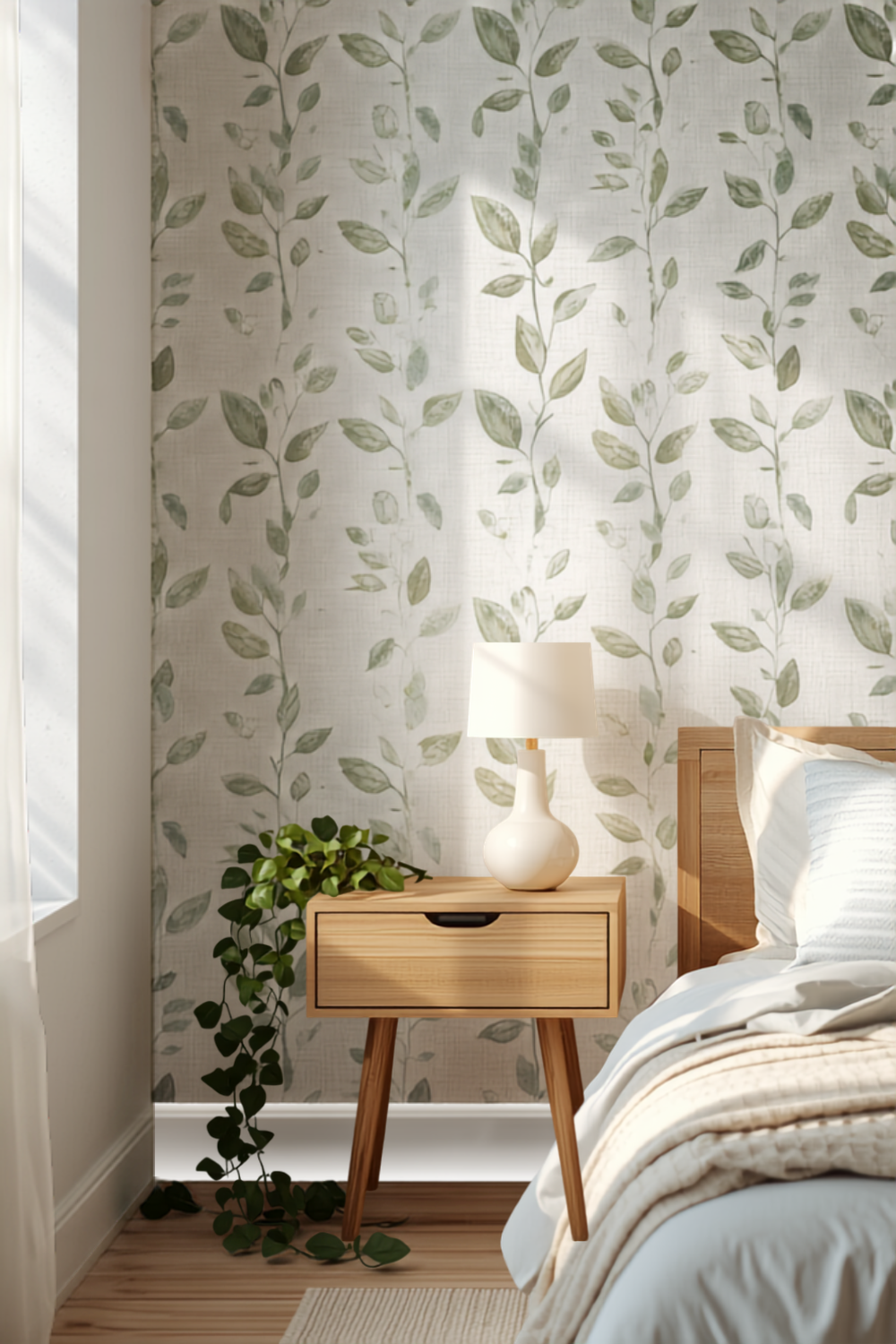
i have wanted a wallpaper wall for approximately my entire adult life, and every single time i've talked myself out of it for the same reason: i rent. real paste-up wallpaper is a commitment to a wall i don't own, and the horror stories about steaming it off and losing your deposit are enough to kill the dream before it starts. so my accent wall sat in the someday pile for years, filed under things-homeowners-get-to-do.
then i actually did it in an afternoon with peel-and-stick, and the someday pile lost a resident. i used the haokhome boho botanical leaf peel and stick wallpaper in the soft green-and-white print, and the whole thing — measuring, cutting, sticking, squeegeeing — was one saturday with an iced coffee. here's what you're working with before we get into the math and the method:
affiliate link
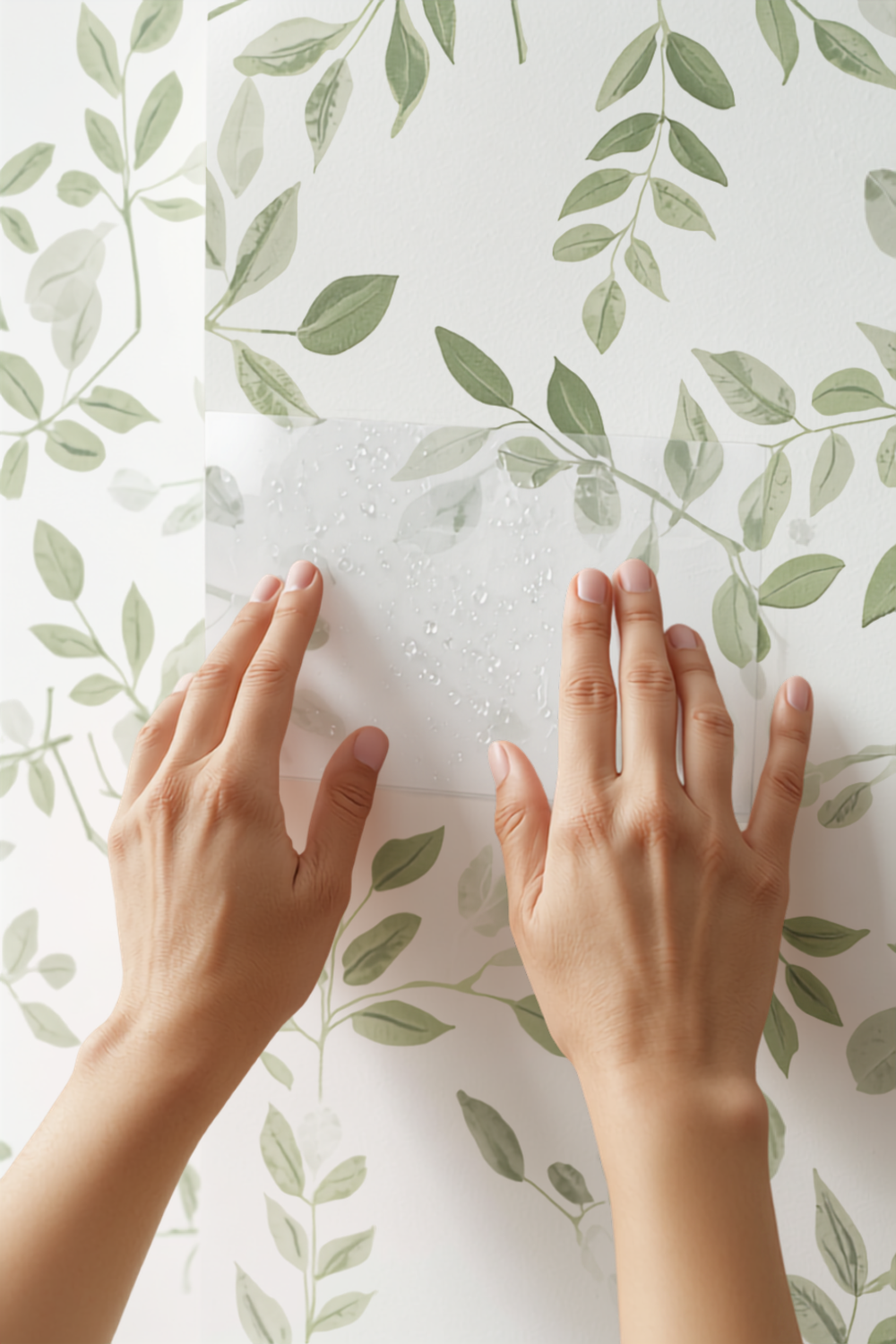
- textured matte vinyl, fully peel-and-stick — no glue, no paste tray, no water tray, no sizing the wall; the adhesive is on the back and you peel the liner as you go
- removable and repositionable with no residue — the whole renter case; you can lift and re-place a strip while you work, and it comes off clean when your lease is up instead of taking the paint with it
- waterproof and wipeable, so it survives a bathroom, a kitchen nook, or a bedroom wall a plant occasionally drips on
- gridded, measured backing paper printed with a cutting grid, so you can cut straight strips to length without a separate ruler — sold per roll at 17.3 inches wide by 9.8 feet long
the honest roll math (do this before you buy)
this is the step everybody skips and then rage-orders a second batch mid-project, so let's do it properly. each roll is 17.3 inches wide. a standard accent wall behind a bed is about 8 feet wide by 8 feet tall. here's the calculation:
- how many vertical strips. your wall is 8 ft = 96 inches wide. divide by the 17.3-inch roll width: 96 ÷ 17.3 = 5.5 strips. you can't buy half a strip, so round up — you need 6 strips to cover the width.
- how much length each strip eats. your wall is 96 inches tall. one roll is 9.8 ft = about 117 inches long. that's enough for one full-height strip with roughly 21 inches left over — but that leftover is not enough for a second full strip, and you'll sacrifice more of it to lining the pattern up (see below). so plan on one roll per full-height strip.
- the total. 6 strips at one roll each = 6 rolls for a standard 8×8 wall. always buy one extra roll on top of that for mistakes and pattern-matching loss, so realistically 6–7. round your own wall's numbers the same way.
the good news on cost: this print usually sits around $9-ish a roll (hedge that — prices bounce and it goes on sale), so six rolls plus a spare lands your whole accent wall under $60-ish. that's the honest headline — a full statement wall for less than a nice dinner out. still measure your actual wall and do the two divisions, because running out with two strips left to hang is the worst feeling in home projects.
the application walkthrough
the trick to a wall that looks intentional instead of dorm-room is that the very first strip is perfectly vertical. every strip after it copies the first, so if strip one leans, the whole wall leans. here's the order i worked in:
- start with a plumb line, not the corner. walls and corners are never actually straight. measure 17 inches out from your starting corner and drop a plumb line (a weighted string, or the level on your phone against a pencil mark) top to bottom. line the edge of strip one to that, not the wall edge. this is the single most important step.
- peel a little, stick, then peel as you go. don't rip the whole backing off at once — it'll fold onto itself and bond, and you'll cry. peel about a foot, line up the top, press it down, then work downward peeling the liner a section at a time.
- squeegee out from the center. use a felt squeegee (or a clean kitchen sponge, or a credit card wrapped in a cloth) and push bubbles from the middle outward toward the edges, top to bottom. small bubbles you can chase to the nearest edge; a stubborn one, poke with a pin and smooth flat.
- overlap the seams, match the pattern. each new strip overlaps the previous one by a hair, and you slide it up or down until the leaf pattern lines up across the seam before you commit. this is where your leftover length disappears — matching a pattern means one strip might start a few inches higher than its neighbor. trim the top and bottom flush with a sharp blade at the very end.
what it actually looks like up close
the thing photos undersell is the texture read. from across the room it's a soft watercolor botanical — green leaves and stems washed over a white ground — that makes the whole corner feel considered. up close, at zoom, the vinyl is genuinely textured and matte, and the painterly leaf detail holds; it doesn't go plasticky or pixelated the way cheap peel-and-stick can. the green-on-white palette is calm enough that it reads grown-up, not loud, and the white base bounces warm lamp light instead of muddying it. seams, if you matched them, basically disappear at conversational distance.
honest pros and cons
pros: it's genuinely renter-safe — that's the whole reason it exists, and it peels off clean at move-out. it transforms a room for the price of dinner-for-a-few instead of a renovation, it goes up in an afternoon with zero specialty tools, and being wipeable means it survives real life. one wall did more for my bedroom than a cart full of decor would have.
cons, real ones: pattern matching takes patience — budget more time than you think for the lining-up, especially on a busy floral. the cost adds up per roll, so the roll math above isn't optional; this is affordable per roll but a big wall needs several. outlets and light switches are fiddly — you cut around them with a blade and it's the slow part. and on textured or freshly painted walls the adhesion is weaker, so it grips best on a smooth, clean, fully-cured wall (give new paint a few weeks first).
if you're doing the whole rental-that-feels-like-yours project, this pairs perfectly with my no-drill window refresh — soft curtains on one wall, a floral accent on another, and suddenly a place you can't paint feels like you chose every inch of it.